
Pioneering the integration of whole-building energy modelling and advanced hydronic simulation.
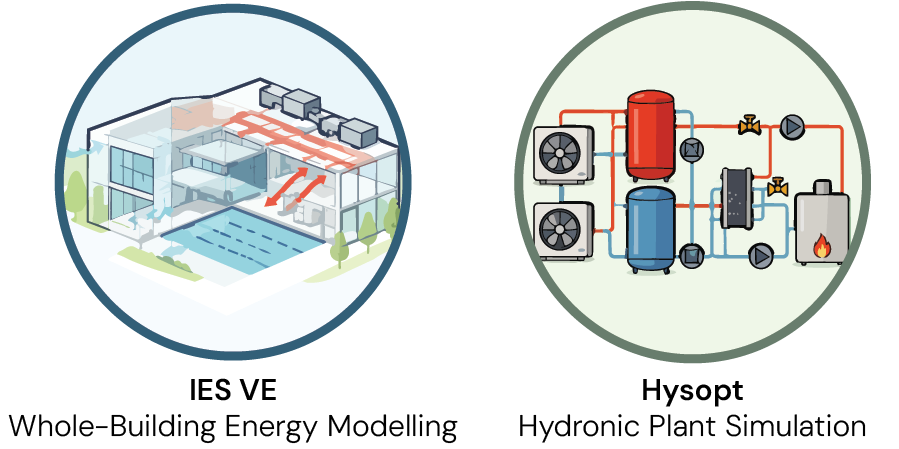
At reLoad, we're taking energy modelling a step further. By combining IES VE whole-building energy modelling with Hysopt's advanced hydronic system simulation, we can better understand how complex heating and cooling systems perform, evaluate design alternatives, and help clients make more informed decisions.
Hysopt is a hydronic system simulation platform that solves thermal and hydraulic behaviour together, allowing us to model how heating and cooling plants operate, including pumps, valves, heat exchangers, thermal storage, and controls. As a Vancouver-based building performance and carbon consulting firm, reLoad is pioneering the combined use of these two platforms in Canada, particularly for complex facilities such as aquatic centres, healthcare facilities, laboratories, and district energy systems.
Why Conventional Energy Modelling Isn’t Always Enough
Energy modelling of complex facilities, such as aquatic centres, laboratories, and hospitals presents unique challenges. These buildings often incorporate highly integrated mechanical systems, complex heat recovery strategies, and multiple interconnected heating and cooling loads.
Most commonly used industry energy modelling software cannot fully represent the complexity of these hydronic systems and central plants without workarounds, approximations, or extensive post-processing. This limits the level of detail available to evaluate system interactions, plant controls, and actual operating performance.
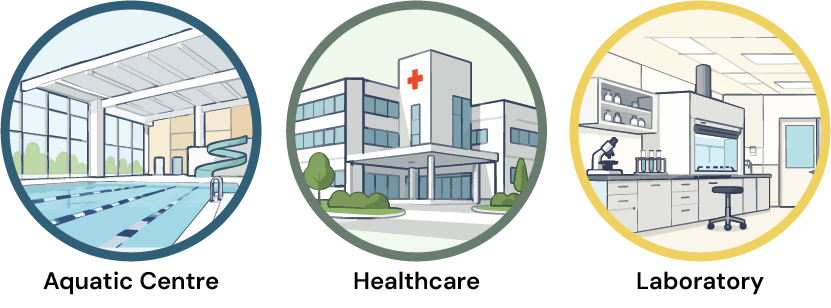
In 2025, to address these challenges, reLoad invested in Hysopt, to complement our existing IES VE whole-building energy modelling practice. Using Hysopt has changed the way we can advise on complex projects. By combining these two tools, we can evaluate complex mechanical systems in greater detail and provide more informed design guidance for aquatic centres, healthcare facilities, district energy systems, and other buildings with sophisticated heating and cooling plants.
Why Aquatic Centres Are Particularly Challenging to Model
Aquatic centres are among the most complex building types to model accurately. Unlike conventional buildings, aquatic facilities involve continuous interactions between pool water, indoor air conditions, heating systems, dehumidification equipment, and heat recovery systems.
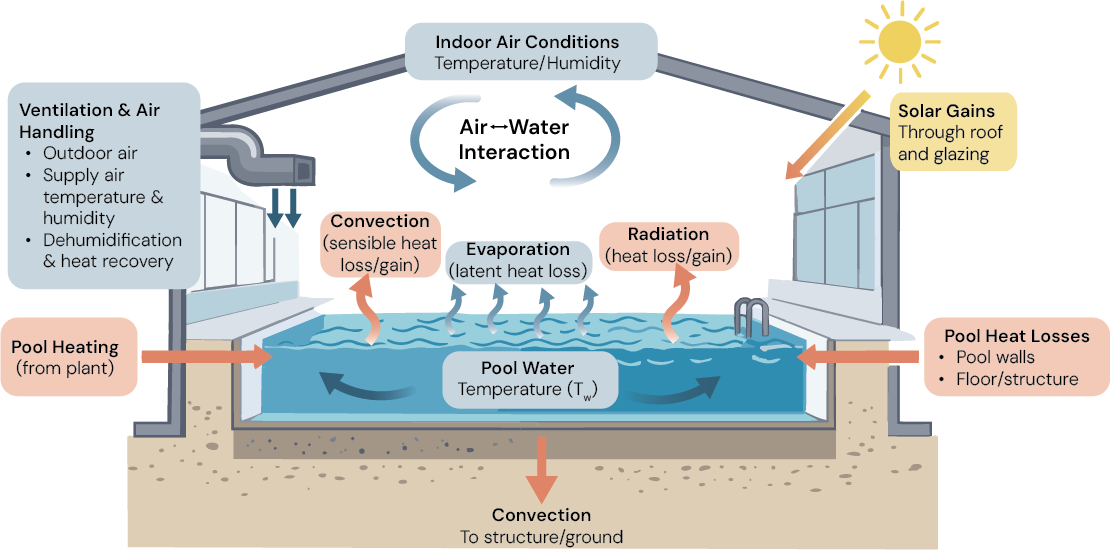
The heat balance between pool water and the natatorium involves evaporation, convection, radiation, and conduction through pool walls and floors. Pool water temperature, indoor air temperature, and relative humidity are closely related, influencing evaporation rates, space conditioning loads, and the energy required to maintain appropriate indoor conditions.
Representing these interactions requires careful calculations and customised modelling inputs. The challenge becomes even greater when facilities incorporate multiple heat pumps, heat recovery systems, thermal storage, and interconnected hydronic loops serving pool heating, domestic hot water, and space conditioning.
Pool Heat Balance: Key Input and Heat Flows
This diagram illustrates the key heat flows affecting indoor swimming pool energy performance, including evaporation, convection, radiation, solar gains, pool heating, and heat loss through the pool structure. These interactions are influenced by pool water temperature, indoor air temperature, humidity, and airflow. Understanding the pool heat balance is essential for accurately modelling aquatic centre energy consumption, heating and dehumidification loads, and overall building performance.

Beyond Conventional Modelling: Connecting Building Loads with Hydronic Plant Performance
By combining IES VE and Hysopt, reLoad can now model complex mechanical systems at a level of detail that is difficult to achieve using conventional whole-building energy modelling software such as IES VE or EnergyPlus alone.
Conventional energy modelling software often assumes that heating and cooling energy is effectively transferred from central plants to terminal units, without fully accounting for hydraulic interactions. In reality, incompatibilities between hydronic circuits can affect the delivery of heating and cooling, even when central plant equipment is properly sized.
While conventional energy modelling primarily focuses on thermal performance, Hysopt enables both thermal and hydraulic system calculations through a combined thermal and hydraulic equation solver.
IES VE provides the flexibility to model highly customised airside systems, including individual HVAC network components, control setpoints, and complex air-handling configurations. This is particularly valuable for natatoriums with custom dehumidification and heat recovery systems, as well as hospitals and laboratories with complex ventilation requirements.
Hysopt takes this level of detail to the hydronic side. Rather than approximating plant operation through simplified system representations, Hysopt allows us to model the actual hydronic schematic, including different heating and cooling equipment, buffer tanks, pressure dependent pump controls, control and balancing valves, heat exchangers, low-loss headers, different piping bypasses, ground borehole and aquifer thermal energy storages, thermal storage tanks, heat interface units, change over systems, system peripherals, and individual control points.
We can evaluate operation of individual equipment in detail, including seasonal performance, annual start/stop cycles, energy contribution balance between plant equipment based on loads, flows, pressure, temperature, capacity, and part-load performances. We can investigate complex heat recovery arrangements with multiple heat recovery loops, and custom build configurations of water-to-water heat pumps operating in tandem with air-to-water heat pumps and active heat recovery coils, different water temperature regimes, cascading supply and return water temperature designs, thermal storages, boilers, preheat while accounting for actual flow rates, and temperature differences, and available heating and cooling loads throughout the system. We can also investigate serial, parallel, and bypass hydronic connections for heating and cooling equipment to improve equipment utilisation and operating performance.
This significantly reduces the need for simplifying assumptions, complicated workarounds, and separate post-processing calculations, while providing much greater insight into how the plant will operate under different conditions.
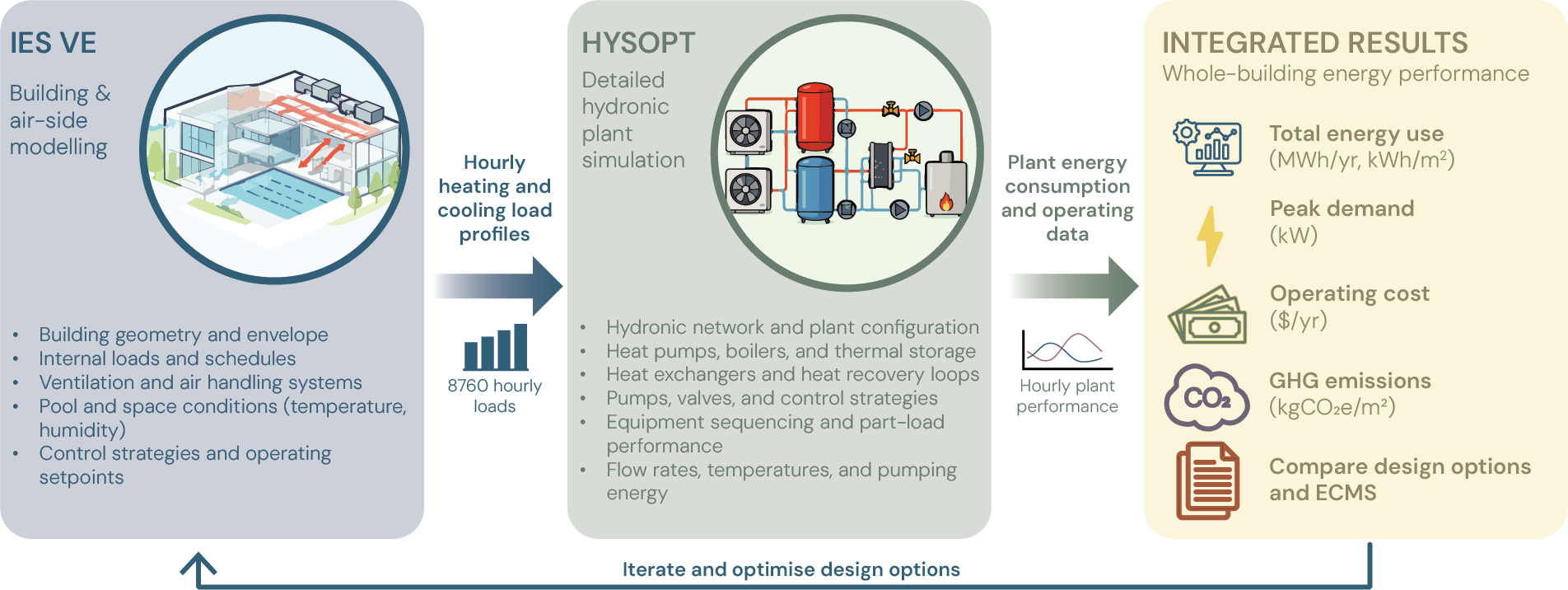
By transferring hourly heating and cooling loads from IES VE into Hysopt and integrating the resulting plant energy consumption with IES VE outputs, we can evaluate detailed hydronic plant performance within the context of overall building energy consumption.
Putting Advanced Modelling into Practice
On a large aquatic and recreation facility in British Columbia, reLoad used integrated IES VE and Hysopt modelling to evaluate a complex central plant during design, including reversable and polyvalent air-to-water heat pumps, water-to-water heat pumps, booster heat pumps, thermal storage, and multiple interconnected hydronic loops.
As part of the design optimisation process, reLoad evaluated 15 energy conservation measures (ECMs), including several requiring detailed hydronic analysis:
• Thermal storage: Hot and chilled water storage to optimise plant operation.
• Wastewater heat recovery: Recovering energy from pool backwash, drainage, and sewage systems.
• Hot tub heat recovery: Evaluating nighttime drainage with thermal storage.
• Domestic hot water optimisation: Preheating strategies and associated storage.
• Central plant and value engineering: Comparing various water-to-water heat pumps, air-to water heat pumps and boiler
configurations, equipment sequencing, and control strategies.
The analysis provided the design team with a stronger basis for comparing energy conservation measures, evaluating operating costs, and optimising the mechanical design before construction.
Better Modelling for More Confident Design Decisions
The greatest benefit of combining IES VE and Hysopt is the increased confidence we can provide in design guidance and cost-benefit studies for complex mechanical systems.
Rather than relying on simplified assumptions about plant operation, we can evaluate how individual components interact throughout the year, test alternative equipment configurations and control strategies, and assess their impact on overall energy performance.

Design optimisation: Evaluating alternative plant configurations, optimal equipment sizing, heat recovery strategies, and control sequences to identify opportunities for improved performance and reduced capital costs.

Plant performance: Modelling equipment operation, part-load efficiency, pumping energy, and hydraulic interactions to better predict how complex hydronic plants perform throughout the year, including how effectively heating and cooling are delivered from central plants to terminal units.

Cost-benefit analysis: Comparing mechanical design options based on predicted energy consumption, operating costs, and long-term performance to support informed investment decisions.
Through close collaboration with mechanical design teams, this level of analysis can lead to better-performing systems, reduced capital and operating costs, and greater confidence in design decisions.
These capabilities are equally relevant to existing buildings, where detailed hydronic modelling can support central plant upgrades, identifying performance gaps, securing optimal HVAC performance, electrification, decarbonisation, and operational optimisation before owners commit to significant capital investments.
What is Hysopt?
Hysopt is an advanced hydronic system simulation platform. It models the actual hydronic schematic of a heating and cooling plant, with a combined thermal and hydraulic solver, so plant operation can be evaluated hour by hour.
How is Hysopt different from IESVE?
IESVE is a whole-building energy modelling tool that can also simulate hydronic systems, but with limitations for complex plant configurations and controls. Hysopt provides much more detailed hydronic simulation, allowing reLoad to evaluate plant performance and provide better-informed design guidance.
Why is advanced hydronic simulation needed for complex heating and cooling plants?
Conventional energy modelling tools often require simplifying assumptions, complex workarounds, and additional spreadsheet calculations to represent sophisticated hydronic systems. This increases modelling effort and the potential for errors. Advanced hydronic simulation allows us to evaluate these systems in greater detail and with more confidence.
Which buildings benefit most from Hysopt modelling?
Buildings with complex central plants, such as aquatic centres, hospitals, laboratories and district energy systems. It is particularly useful where there are multiple heat pumps, heat recovery loops, thermal storage or several water temperature regimes.
Can Hysopt modelling be used on existing buildings?
Yes. It can support central plant upgrades, help identify performance gaps, and inform electrification and decarbonisation decisions before owners commit to major capital spending.
Moving Beyond Compliance Modelling
At reLoad, we believe energy modelling should do more than demonstrate compliance with energy codes or sustainability targets. It should be a tool for making better design and operational decisions.
Combining IES VE airside modelling with Hysopt hydronic plant simulation has significantly expanded our ability to evaluate complex mechanical systems and provide more accurate, detailed design guidance for aquatic centres, healthcare facilities, and other buildings with sophisticated central plants.
Working on a project with complex hydronic systems, central heating and cooling plants, or integrated heat recovery?
We would be happy to discuss how this advanced modelling approach can benefit your project.