
Advancing Thermal Resilience in New Multi-Unit Residential Buildings
Designing for tomorrow's climate starts with the buildings we design today
Extreme heat is becoming an increasingly important consideration in building design. Multi-unit residential buildings (MURBs) are difficult to retrofit for overheating once constructed, making passive thermal resilience an important design consideration.
What is the Advancing Thermal Resilience in New MURBs (TRiM) Study?
The TRiM study is one of the first in Canada to evaluate overheating using both comfort-based and physiological health risk metrics. By combining a National Resource Canada (NRC) health-based overheating risk methodology with traditional overheating hours analysis, the study provides a more complete understanding of how passive design strategies influence occupant comfort, health, and building resilience.
The TRiM study was undertaken to:
Improve understanding of overheating risk in new MURBs under future climate conditions.
Evaluate passive thermal resilience strategies based on their performance, practicality, cost, constructability, and market availability.
Assess overheating methodologies to better represent occupant health risk and thermal resilience.
Provide evidence to inform future guidance, industry practice, research, and consideration of future policy.
Introducing the NRC Overheating Risk Framework
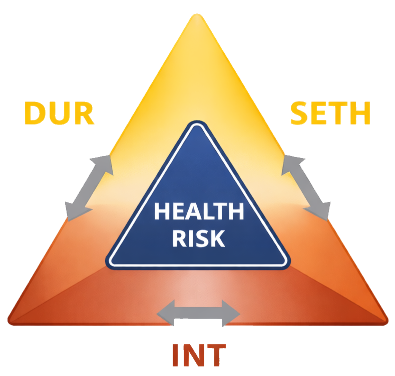
To better represent occupant health risk during prolonged heat events, the study recommends transitioning from a reliance on comfort-based overheating-hour metrics towards the use of the NRC Overheating Risk Framework, which better captures cumulative physiological exposure, nighttime recovery, and heat-health risk.
Unlike traditional overheating assessments that only measure the number of hot hours, the NRC framework evaluates cumulative heat exposure and its potential impact on occupant health. It considers the intensity (INT), duration (DUR), and cumulative heat (SETH) of heat events to provide a more complete measure of thermal resilience.
Study Highlights
Overheating risk is not limited to extreme heat evens and can occur during prolonged periods of elevated temperatures
Evaluation of thermal resilience should include extreme heat event and Urban Heat Island (UHI) scenarios in addition to typical weather-year analysis
Multiple passive design pathways evaluated in the study achieved comparable reductions in overheating risk across archetypes
Reduction in overheating risk was primarily driven by solar heat gain reduction and improved passive ventilation effectiveness
Implementation of passive measures is influenced more by project cost, coordination, and delivery considerations than by availability of the measures themselves
Residual overheating risk may still require targeted mechanical cooling in some conditions
Delayed action increases future retrofit complexity, cost, and regulatory risk
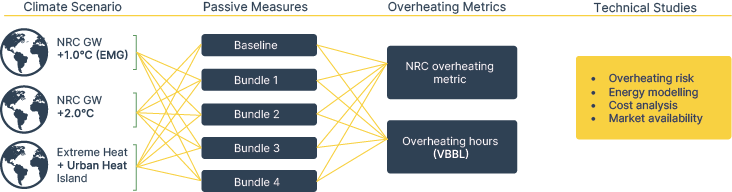
Overview of how the TRiM Study was conducted
In Numbers
81% to 90%
Reduction in overheating hours across all archetypes through passive design strategies.
71%-95%
Reduction in duration and severity of overheating health-risk events across all archetypes through passive design strategies.
<1%
Increase in total project cost for the best-performing passive design bundles.
4
Passive design bundles evaluated across the MURB archetypes for thermal resilience, energy, cost, market availability, and constructability.
3
Building archetypes modelled: 6, 12, and 35 storeys.

This was a truly collaborative effort involving the City of Vancouver, UBC Campus & Community Planning, BC Hydro, reLoad Sustainable Design Inc., RGS Consultants, Ryder Architecture, Glotman Simpson, Chorus Consulting Inc., Peak Construction, and a fantastic Advisory Group.
Thank you to everyone who contributed their expertise throughout the project.
You can read the full, publicly available report on the City of Vancouver website: https://vancouver.ca/files/cov/id-heat-health-risk-new-murb.pdf