
reLoad Research Presented at eSIM 2026
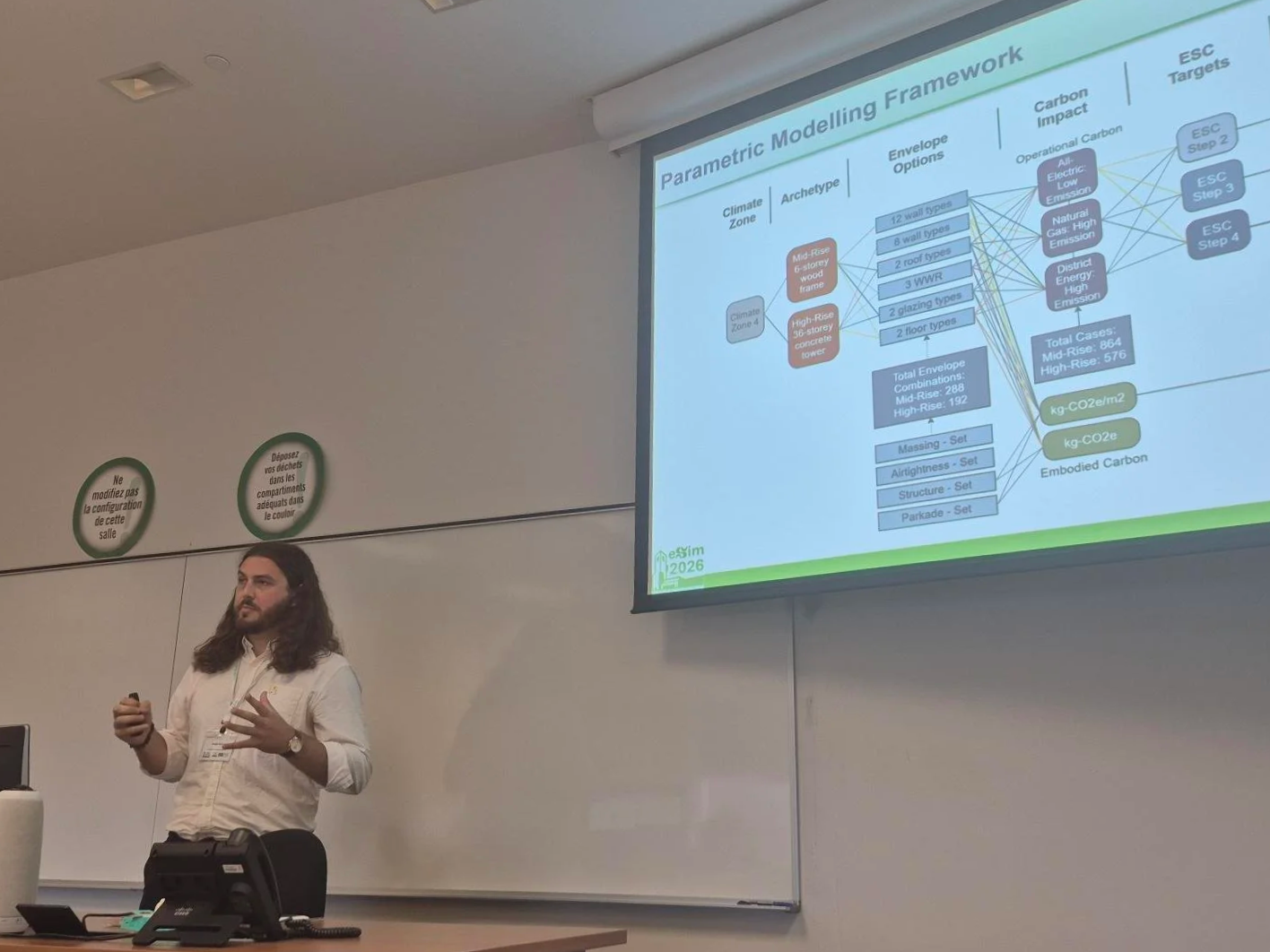
Hugh presenting at eSIM 2026 in Montreal
One of the highlights of eSIM 2026 for the reLoad team was seeing Hugh present our latest research on balancing whole building carbon in the context of BC's Energy Step Code and Zero Carbon Step Code.
Presented to an audience of building performance researchers and industry professionals, the study explores how envelope design decisions influence operational energy, embodied carbon, and capital cost. Rather than evaluating these factors independently, the research demonstrates the value of considering them together to support more informed design decisions.
At the centre of the presentation was a decision support tool developed by the project team. The tool combines energy modelling, whole building life cycle assessment (wbLCA), and capital cost analysis into a single workflow, allowing design teams to compare envelope strategies across multiple performance metrics.
The research highlights an important challenge facing the industry. Optimising for operational energy alone does not always produce the lowest whole building carbon outcome. As operational emissions continue to decline, understanding the balance between embodied carbon, operational carbon, and project cost becomes increasingly important.
It was great to see the work shared with the wider building performance community and to contribute to the ongoing discussion around practical approaches to delivering lower carbon buildings.
A sincere thank you to our client, Campus and Community Planning at UBC Vancouver, represented by Ralph Wells, and to our funding partners, BC Hydro and the Natural Resources Canada (NRCan) Codes Acceleration Fund, for making this research possible.
We also thank our project partners, Ryder Architecture, Glotman Simpson Consulting Engineers, and Heatherbrae Builders, whose expertise and collaboration were invaluable throughout the study. The project was led by Martina Söderlund with support from the broader reLoad team.
We'll be sharing more from the research in future articles, including key findings and what they mean for project teams designing buildings under BC's evolving energy and carbon requirements.